Supporting Group Decision Making
This session is designed to help you support a team or collaborative group in working together to reach a decision. We will introduce the diamond model of participatory decision making as a framework for group process design and facilitation. You will learn to recognize the stages of participatory decision making and the type of thinking (divergent, emergent, or convergent) required for each stage. We will identify potential obstacles in each stage and practice tools and techniques to support innovative thinking, integration, and convergence / decision making. We’ll discuss the importance of clarity about how a decision will be made and by whom and explore how to select the appropriate decision making model for a given context.
Participatory Decision Making
Every facilitated process will reach a point where the group needs to make a decision, even if it’s just whether to break for lunch. This module aims to equip you with the tools to support the group in making those decisions skillfully. We’ll also learn to recognize when a group decision making process is worth the time and effort and when the group would be better served by a single decisionmaker making the call.
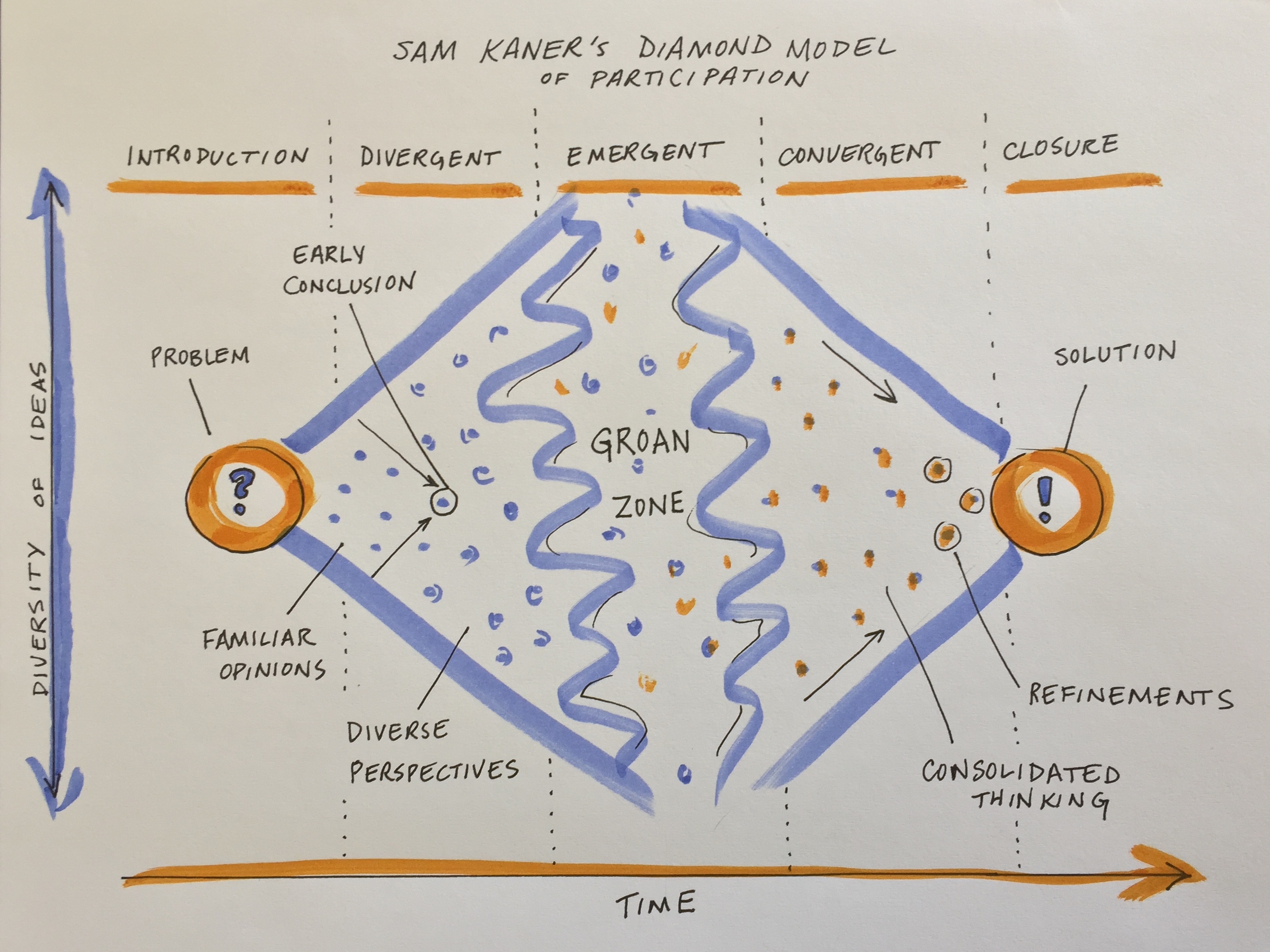
Sam Kaner’s diamond model provides a fundamental framework for understanding and facilitating participatory decisionmaking (Kaner et al. 2014). It starts with problem definition and then moves through three phases, each characterized by a different style of thinking - divergent, emergent, and convergent. The diamond culminates with a solution to the problem - a decision. In this module we offer techniques to support each of those stages and ensure that ultimately, your group reaches that decision.
Moving from Debate to Dialogue
Before we dive into the diamond model, let’s distinguish four different forms of discourse and how they play into participatory decisionmaking. Dialogue is a collaborative effort to understand and learn from each other. Debate, on the other hand, is an oppositional effort to convince the other side that you are right. Skillful discussion has informed, objective decisions as its goal. Polite discussion, by contrast, often masks the fact that decisions are being made based on relationships and feelings rather than evidence. See the tabs below for more on how these styles differ.
- Intent to win
- Listening to be understood
- Power struggles
- Competition “turf war”
- Loudest wins
- Ideas judged by who says them
- Intent to protect self, others
- Surface friendly
- Ideas judged by friendships/relationships
- Impulsive, based on feeling, low data
- Influence occurs outside the meeting
- Limited active or empathetic listening
- Intent is closure; informed decisions
- Balance influence and inquiry
- Focus on issues not personalities
- Reasoning is made explicit
- Ask about assumptions without criticizing
- Influence is based in logic and data
- Intent to build mutual understanding
- Listening to understand thoughts and feelings
- Able to suspend assumptions
- Energy used to find the right questions
- “Container” for collective thinking
- Influence is found in shared meaning created by groups
Your role as a facilitator is to support inclusive dialogue and skillful discussion. When wrestling with complex topics, dialogue allows groups to recognize the limits on their own and others’ individual perspectives and to strive for more comprehensive and coherent understanding. Dialogue becomes a container for collective thinking and exploration (especially during divergent and emergent thinking stages) - a process that can take teams in directions not imagined or planned. In dialogue, all views are treated as equally valid, and different views are presented as a means toward discovering a new view. Participants listen to understand one another and make shared meaning, not to win.
When it comes time to make a decision, skillful discussion is required. This stage calls on us to be adept at giving and receiving feedback - separating people from their positions, speaking candidly, listening actively, and not taking criticism personally. As a facilitator, you can further support skillful discussion by addressing power dynamics and biases that might affect the group’s ability to make an objective decision. Be conscious of hierarchies that might affect how people participate and the weight given to their views (see Power Dynamics).
Both skillful discussion and dialogue are critical to the collaborative process, and the more artfully a group can move between these two forms of discourse (and out of less productive debate and polite discussion) according to what is needed, the more effective the group will be.
Active Listening
Cultivating the presence and skills to be a good active listener will support your facilitation throughout all stages of group decision making. Active listening is listening to understand, rather than react. Try these active listening practices:
- Be fully present
- Use positive body language and nonverbal cues
- Avoid interrupting or judging
- Paraphrase or mirror back to check your understanding
- Ask clarifying and/or open-ended questions
- Validate where they are coming from / how they are feeling
- Don’t give advice unless asked
- Summarize main themes, ideas, or action items
Embracing Divergent Thinking
The first stage of group decision making is divergent thinking (Kaner et al. 2014). Confronted with a new, complex topic, the group will gradually move from the safe territory of familiar opinions into sharing their diverse perspectives and exploring new ideas. This can feel like the group process is devolving away from what was assumed to be shared agreement about purpose or direction, but it is actually a critical part of the collaborative process.
When a diverse group comes together to work on a complex problem, their views are likely to diverge widely across many dimensions from problem definition to priorities to approaches to the definition of success. But you can tap that divergent thinking to generate entirely new ideas and options that emerge through the group’s productive struggle for mutual understanding.
While your group is in the divergent thinking stage, it’s critical to foster dialogue to surface different perspectives. Guard against action bias which can lead to impatience with deliberation and hasty decisionmaking. Encourage disagreement and questioning. Examine hidden assumptions. Amplify diverse perspectives–and particularly, voices from the edge (e.g., junior members, new collaborators, people from different backgrounds, community members and other people who may be affected by the project)–in order to expand the range of possibilities. Mirror and validate what you hear. Invite people who are good at bridging perspectives to help translate and build shared understanding across different ways of thinking. Suspend judgment and encourage full participation.
Beware of the most common pitfall at this stage, which is to converge too quickly on an early conclusion, staying in the safe space of familiar opinions and status quo solutions. You can prepare for this stage and help to avoid that pitfall by reviewing prior work, seeking input from different perspectives (e.g., through interviews, surveys, focus groups, guest speakers, or field trips), and synthesizing information and knowledge gaps, promising approaches, and critical questions. Your team can use that synthesis of the current situation as a jumping off point.
Making it Through the Groan Zone
It’s natural for groups to go through a period of confusion and frustration as they struggle to integrate their different perspectives into a shared framework of understanding (Kaner et al. 2014). The goal is to get the group across this no man’s land between divergent thinking and convergence known as the “groan zone”. In the groan zone, the group leader or facilitator’s job is to keep the group from getting frustrated and shutting down.
While the groan zone can be challenging, it can also be an extremely fruitful and creative stage. Here in the messy middle of a group process, an open and flexible mindset and a process that invites participants to engage in emergent thinking can enable true innovation. Emergent thinking builds upon ideas generated in the divergent thinking stage, recombining or adapting them in novel ways. It seeks to identify patterns and make meaning in the face of complexity and uncertainty. Done well, emergent thinking enables a group to adapt, sense opportunities, and generate new and exciting ideas.
Some useful techniques for navigating the groan zone and fostering emergent thinking include:
- Cultivating presence and patience
- Active listening
- Building shared understanding via translation (e.g. across different ways of knowing), metacognition (thinking about how you are thinking), and inquiry
- Exploring new information, models, and ways of presenting information
- Creating categories to reveal structure and allow sorting and prioritization of ideas
- Combining or recombining ideas or methods to yield new approaches
- Working together to separate facts from opinions
- Carefully examining language, e.g. by looking word by word at a key statement or question that is being debated and asking what questions each word raises
- Capturing side issues in writing and reserving time to revisit these – taking the tangents seriously is a critical part of letting participants know you value their contributions
- Examining how proposed ideas might affect each individual or organization in the group
- Honoring objections to the process and asking for suggestions
- Addressing power imbalances and elevating voices from the “edge”
Some typical obstacles to emergent thinking include:
- Differences in training, background, and vocabulary that impede understanding
- Analysis paralysis - getting lost in the weeds of endless analysis and detail
- Polarization - opposite camps anchored in
- Power dynamics that squelch creative contributions from the “edges”
- Avoidance of a deeper issue impeding collaboration (e.g. lack of trust)
- Turf wars, competition
- Risk aversion, perception management, fear of failure / getting it wrong
- Confirmation bias and resistance to ideas that challenge group identity and beliefs
If you find the conversation getting off track or the dynamics becoming difficult, useful techniques that allow you to remain committed to being supportive and respectful of all group members (including ones you might experience as “difficult”) include:
- Reminding individuals of the larger purpose of the group and reconnecting them to their own personal reasons for caring about and working on the issue, e.g. by inviting them to take a moment to reflect or to restate what success looks like
- Focusing on common ground and areas of potential alignment
- Inviting constructive opposition - ask the critic to say what they can support about a given proposal and what they would like to see changed or discussed further (see Reading the Room for more tips)
- Switching the participation format (e.g., going to breakout groups, brainstorming, a go-around, or individual writing)
- Taking a break
- Stepping out of the content and addressing the process (i.e., making a bystand move)
- Educating members about group dynamics and asking them to reflect on how they are showing up
- Encouraging more people to participate
- Reframing the discussion, e.g. by surfacing underlying issues, and/or focusing on concrete actions that the group can take to resolve the conflict
Don’t get discouraged by the groan zone. Misunderstanding and miscommunication are normal parts of the process of collaboration. And even more importantly, “the act of working through these misunderstandings is what builds the foundation for sustainable agreements [and]… meaningful collaboration” (Kaner et al. 2014).
Getting to Convergence
Once the group has a strong foundation of shared understanding, things often start to click into place and feel easier and faster as you enter the zone of convergent thinking. At this point, the group is ready to devise inclusive solutions, weigh alternatives and make decisions. As the group leader your role is to help the group craft specific proposals, evaluate and decide among them, refine and synthesize into an overall approach, and lay out a concrete plan. The risk at this stage is that the group never converges on a clear decision or plan, leading the group to spin its wheels in the future.
Discuss as a team who is ultimately responsible for making the decision and how will the group be engaged - what is your decision making process going to be? Will it be based on consensus? Majority rules? Or will you delegate the decisionmaking to the team leader or a sub-team who are closest to the decision? What’s your fallback plan if you can’t reach a decision during your time together? The figure below arrays a variety of different decisionmaking processes onto the axes of level of group member involvement and level of group member ownership. Note that the two red circles that are off the graph in the bottom left should definitely be avoided!
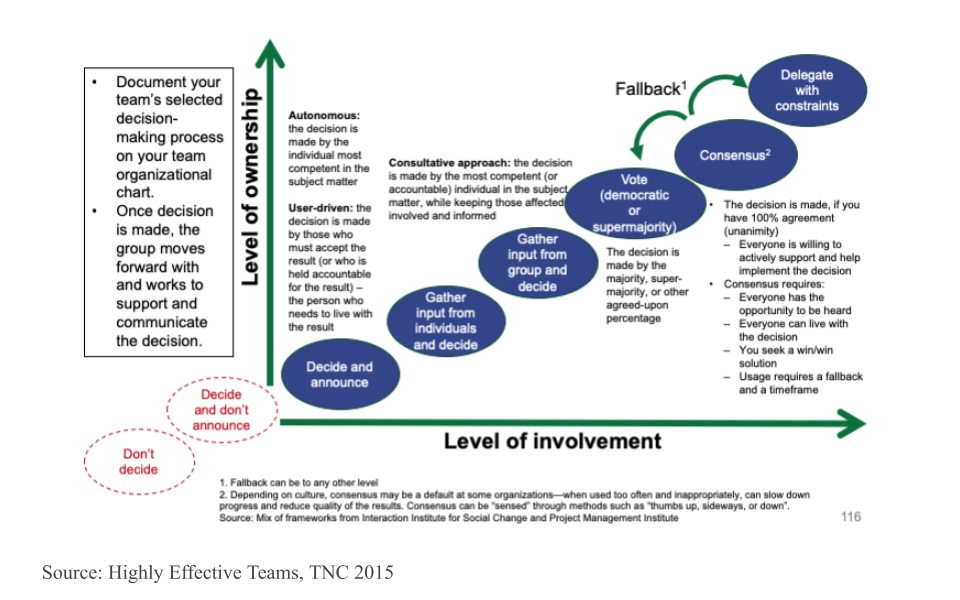
Pick your decision model to suit your context. Consensus and other participatory decision making processes take time and effort and shouldn’t be used for every decision. Small decisions, low risk decisions, and those that sit squarely within one person’s authority don’t need to be made by consensus. For bigger decisions, consider, what’s more important - speed or group ownership? Which will be more costly to your group: a missed opportunity that results from moving too slowly or an uninformed / bad decision? Is this decision a one-way door or is it easily reversible? Is the proposal safe to try? If moving quickly is valuable and the proposal constitutes a safe-to-try experiment that won’t jeopardize your mission, you may want to empower an individual or team to make the decision and act.
Consent Process
Consider a consent decision making process to reach safe-to-try decisions with these rounds:
- Offer proposal
- Field clarifying questions
- Invite and listen to reactions to the proposal
- Restate proposal (with or without changes)
- Listen to objections - “Do you see any reasons why adopting this proposal would cause harm or move us backward?”
- Amend proposal to address objections
- Ratify proposal if all objections have been addressed
Decisionmaking checklist
-
- Consensus - everyone agrees
- Consent - no one objects
- Majority rules
- Delegate to an individual or group
DARCI
A DARCI grid can clarify who is the decision maker and who will be affected by the decision.
| Task | Decisionmaker | Accountable | Responsible | Consulted | Informed |
|---|---|---|---|---|---|
| These people have the ultimate and final approval or veto power | This single person is accountable for ensuring the work gets done | These are the people who are responsible for contributing to the work | Those from whom input will be solicited | Those to be kept apprised of relevant developments | |
| Workstream 1 | Name | Name | Name | Name | Name |
| Workstream 2 | Name | Name | Name | Name | Name |
Techniques to support convergence:
Convergent thinking requires critical analysis of alternative ideas and active listening. Useful techniques in this phase include:
- Define the decision clearly; frame the challenge while staying open to a range of possible solutions
- Invite concrete, written proposals
- Leave space for thinking and metabolism of ideas (reflection, movement, writing, or research time)
- State your selection criteria and get clear about how you will evaluate proposals against them (see feasibility-impact matrix)
- Assess levels of agreement (see Fist to Five)
- Combine the best elements of multiple ideas to support more innovative, inclusive solutions
- Before the final decision, narrow the pool of possible options to a manageable set (2-5)
- Decide what ideas to pursue and which to keep on the back burner in case the team needs to adapt
- Define next steps, assess capacity, and assign roles and responsibilities
While the big work of the initial stage of any project is getting to convergence on the overall work plan, you should expect that your team will go through the process of divergence and convergence many times as you dive into the work and uncover new challenges. But the shared understanding and social rapport that come from successfully struggling together early on will allow the group to more easily and rapidly develop and implement new solutions in subsequent meetings.
A Framework for Group Process Design
The diamond model is not only a conceptual model of the common flow of participatory decisionmaking dynamics – it is also a tool you can use to design good group processes.
Have you ever been in a meeting that generated tons of ideas, but left you wondering whether any of it was going to go anywhere? That group process neglected to engage in convergent thinking. Or have you experienced a leader who hands down dictates with little discussion and expects everyone to just agree? They are missing out on the value of divergent and emergent thinking to generate creativity and buy-in.
A good group process will move through the diamond model and include all three types of thinking. Your process design, whether it’s for a single meeting, a multi-day workshop, or a longer collaborative process, should start by asking yourself, where are we now? What resources, people, and information do we have as our starting point? And where do we want to get to? What is our target end state – the deliverable or outcome we are trying to achieve?
Between those two points - your initial state and your target state - you can use one or multiple diamond shaped activities to productively move your group along. Each microstructure or game you use to engage the group can help to generate new ideas, explore them together, and converge on new insights or decisions. Those insights or decisions can then become the input for the next diamond, until you eventually reach your goal.
Those diamonds can vary in scale from mini-exercises that only take a few minutes to multi-day or longer processes. Once you start to recognize it, you’ll see the diamond model everywhere (or miss it when it’s lacking!).
Tools to Support the Thinking You Need
(D=divergent, E=emergent, C=convergent)
| Microstructure | Stage | Purpose | How It Works | Tips & Traps |
|---|---|---|---|---|
| Brainwriting or brainstorming | D | Surface and elaborate ideas | Brainstorm ideas in a google doc or virtual whiteboard (or on index cards or sticky notes in person); read and add to each other’s ideas; discuss | Follow up with affinity mapping as you move into emergent thinking |
| Turn and learn / chat waterfall | D | Avoid the primacy effect (the first idea getting the most attention and biasing what comes next) by having everyone write down their idea (or their understanding of a situation) and then post them simultaneously on the wall or in a chat | ||
| Rotating Stations | D | Spread good ideas and make informal connections | Set up stations with experts or innovators who can present information and engage discussion; group members circulate to learn, ask questions, or provide feedback | Keep the overall session short so that it’s not too fatiguing for presenters who will have to repeat their spiel many times |
| Pre mortem | DE | Share past learnings and assess risks early | At the start of a project, ask “What will go wrong?” or even “How will this end in disaster?” | Compile and rank the potential risks. Use the pre mortem as a jumping off point for further design discussions. |
| User Experience Fishbowl (a riff on panel discussion) | DE | Draw out and contrast different perspectives from experts or interested parties | Experts with direct experience of the challenge at hand are invited to engage each other in conversation at the center of a circle; the rest of the group are audience to their conversation; audience and facilitator can suggest things for them to discuss | Avoid falling back on traditional formats where panelists talk to the audience rather than each other - the power of the fishbowl is the deep way in which the experts can engage each other |
| Horizon scanning / futures thinking | DE | Detect emerging trends, issues, or research opportunities | Define your scope; consult outside sources of data and expertise or brainstorm within the group to identify emerging trends, events, and weak signals of future change that may affect the question / topic you have defined | Set a timeframe that’s far enough out to encompass important uncertainties but not so far that forecasting becomes overly speculative |
| Affinity Map (clustering) | E | Surface ideas, detect patterns, and analyze | Brainstorm ideas using sticky notes on a wall or virtual whiteboard; cluster into categories | Follow up with prioritization of ideas within clusters as you move into convergent thinking |
| Conceptual models | E | Build a shared representation of the system | Co-develop a figure or diagram that encapsulates your collective understanding of the focal problem or system | Consider mind maps, flow charts, system diagrams; Consider having several small groups attempt this in parallel and compare results |
| World Cafe conversations | E | Engage everyone in making sense of profound challenges | Ask for a volunteer to host each table; use a talking object; Go-around 1: share what you are thinking, feeling, or doing about the theme or topic; Go-around 2: share your thoughts and feelings after having listened to others; Open conversation; Go-around 4: “takeaways” | Start with a clear question or prompt for discussion; Share the agreements and ask hosts to gently facilitate adherence |
| 3D Modeling from the Presencing Institute | E | Uncover hidden dynamics in systems and identify leverage points for change | Co-create a three dimensional model that maps a current situation or system (using small items such as figurines, feathers, pieces of wool, etc. to symbolize elements and dynamics). Reflect on the model, then reshape it to better reflect your preferred future system state. Provides a playful way in to difficult conversations. Add a gallery walk so folks can see each other’s models | |
| What, So What, Now What | EC | Make sense of past progress or experiences and decide on future actions | What - As a group, compile the facts and observations relevant to the context; So What - Reflect on the facts and their implications, identify patterns, generate hypotheses; Now What - Draw conclusions - What actions make sense? | Be firm in calling out opinions being passed off as facts in the What stage. Stick to what is observable. |
| Polling | EC | Rank alternatives | Decide how many votes per person - a good rule of thumb is 1 dot for every 4 or 5 alternatives; In person - use sticky dots; Virtually - use +1s in a google doc or a digital polling tool (e.g., Zoom, Mural, slido) | Before you start - clarify how you will use the results - are you gauging the distribution of support (a heat map) or taking a vote to make a decision? |
| Feasibility x impact matrix | C | Compare alternatives | Discuss and agree on definitions for two criteria for evaluating ideas: feasibility of implementation and impact potential; Rate each idea against these two axes and map onto 2x2 grid | How you define the axes must be clear and agreed upon by everyone before you start |
| Fist to Five / Gradient of Agreement | C | Assess degree of consensus; seek closure | Use when ready to close a discussion or make a decision; Invite participants to rate their level of agreement with a proposal on a scale of 0-5; Five fingers means “absolute, total agreement or support” and a fist means “complete opposition” | If you have some 1s and 2s, more discussion is needed - ask them to explain their concerns or questions |
| Open discussion | DEC | Group inquiry, sensemaking, and/or decision-making | Clearly define the scope; set agreements for inclusive discussion; invite discussion about the topic at hand; capture ideas and questions; listen for when the group is ready to converge | Keep track of side topics (e.g. in a “bike rack”) and make time to come back to them, but don’t let them derail |
| Breakout groups | DEC | Engage everyone deeply; avoid groupthink | Define the scope and intended outcomes; set a time limit; assign roles (facilitator, notetaker, reporter); model what you want in the report out | Consider whether all groups should work with the same prompts or different aspects of the problem |
| Chart writing or whiteboarding | DEC | Reflect participant’s viewpoints back to the group | On a virtual or physical chart or whiteboard, capture key points in the discussion so everyone can see them | Use speakers’ own words; if the comment is long or complex, ask the speaker to give you a headline you can capture |
| 1,2,4,all | DEC | Engage everyone in generating questions, ideas, and suggestions | Individual reflection; Pair share; Two pairs combine and share as a group of 4; Small groups share highlights with whole group | Emphasize novel ideas and distinctions for divergence; common themes and emerging insights for emergence and convergence |
| Round robin / go around | DEC | Hear from everyone; get starting positions on the table | Everyone answers the same prompt. Alternatives to going in order: each speaker calls on someone else after they have shared; popcorn-style - people share in the order that they feel moved to speak | Do not allow discussion until everyone has responded to the initial prompt |
Additional Resources
Papers & Documents
- McCandless, K. & N. White. The Liberating Structures Fieldbook: Flipping the Script on Meetings, Planning, and Progress. Liberating Structures Press. 2026.
- Gray, D. & S. Brown. Game Storming 2.0: An Updated Playbook for Innovators, Rulebreakers, and Changemakers. O’Reilly. 2025.
- brown, a.m. Holding Change: The Way of Emergent Strategy Facilitation and Mediation. AK Press. 2021.
- Stein Greenberg, S. Creative Acts for Curious People: How to Think, Create, and Lead in Unconventional Ways. a Stanford d.school book. Ten Speed Press. 2021.
- Bird, K. Generative Scribing: A Social Art of the 21st Century. PI Press. 2018.
- Lipmanowicz & McCandless. The Surprising Power of Liberating Structures: Simple Rules to Unleash a Culture of Innovation. Liberating Structures Press. 2014.
- Kaner, S. Facilitator’s Guide to Participatory Decision-Making (Revised). 2014.
- Kantor, D. Reading the room: Group dynamics for coaches and leaders. John Wiley & Sons. 2012.
- Kahneman, D. Thinking, Fast and Slow. Farrar, Straus and Giroux, 2011.
- Gray, D. et al., Gamestorming: A Playbook for Innovators, Rulebreakers, and Changemakers. O’Reilly Media. 2010.
- Whitney, D. & A. Trosten-Bloom. The Power of Appreciative Inquiry: A Practical Guide to Positive Change. 2nd edition. Berrett-Koehler Publishers. 2010.
- Bohm, D. On Dialogue. Routledge Classics. 2004.