Understanding Your Team: Thinking and Working Styles, Working Agreements
Much of the friction on teams comes not from bad intentions, but from expectations nobody ever said out loud. One person assumes a quick reply on email is part of the job, while another expects to answer at the end of the day. One wants an agenda a day ahead, and another is happiest improvising. Neither is wrong. They just have different needs and defaults, and no one has talked about them.
This session will unpack what makes you and your colleagues or collaborators tick and the implications for how your team works together. We’ll explore individual thinking preferences, work styles, and values to deepen understanding and empathy across your team. Participants will gain practice in co-developing working agreements to ensure an inclusive and supportive environment in which all team members can show up fully and do their best work.
Why Understand Your Team?
This session is organized around a single question:
What do I need, what do you need, and how do we agree to work together so everyone can do their best?
We will look at it through two lenses and then put them to work:
- Thinking preferences help us understand how I like to work: what we reach for, expect, and enjoy when things are going well.
- Our many parts help us understand what happens when it gets hard: how different parts of us can take over under pressure.
- Working agreements are how a team plans for both.
We start with preferences because they are the easiest to talk about, and then go a layer deeper. You can borrow this sequence when you work with your own teams and clients: begin with what is low-risk and easy to discuss, then build toward what takes more trust.
Thinking Preferences: The Whole Brain Model
People have different thinking preferences, and those preferences influence what we expect and enjoy in group processes. Ned Herrmann’s Whole Brain Model offers a simple, memorable way to talk about those differences.
Herrmann’s model uses the brain as a metaphor. The neocortex is associated with intellectual, cerebral thinking and the limbic system with instinctive, emotional thinking. The left hemisphere is associated with rational, analytical, systematic thinking, and the right hemisphere with intuitive, artistic thinking. Combining these gives four quadrants, each associated with a different thinking style. As with any model, treat it as a useful lens and not a literal map of the brain.
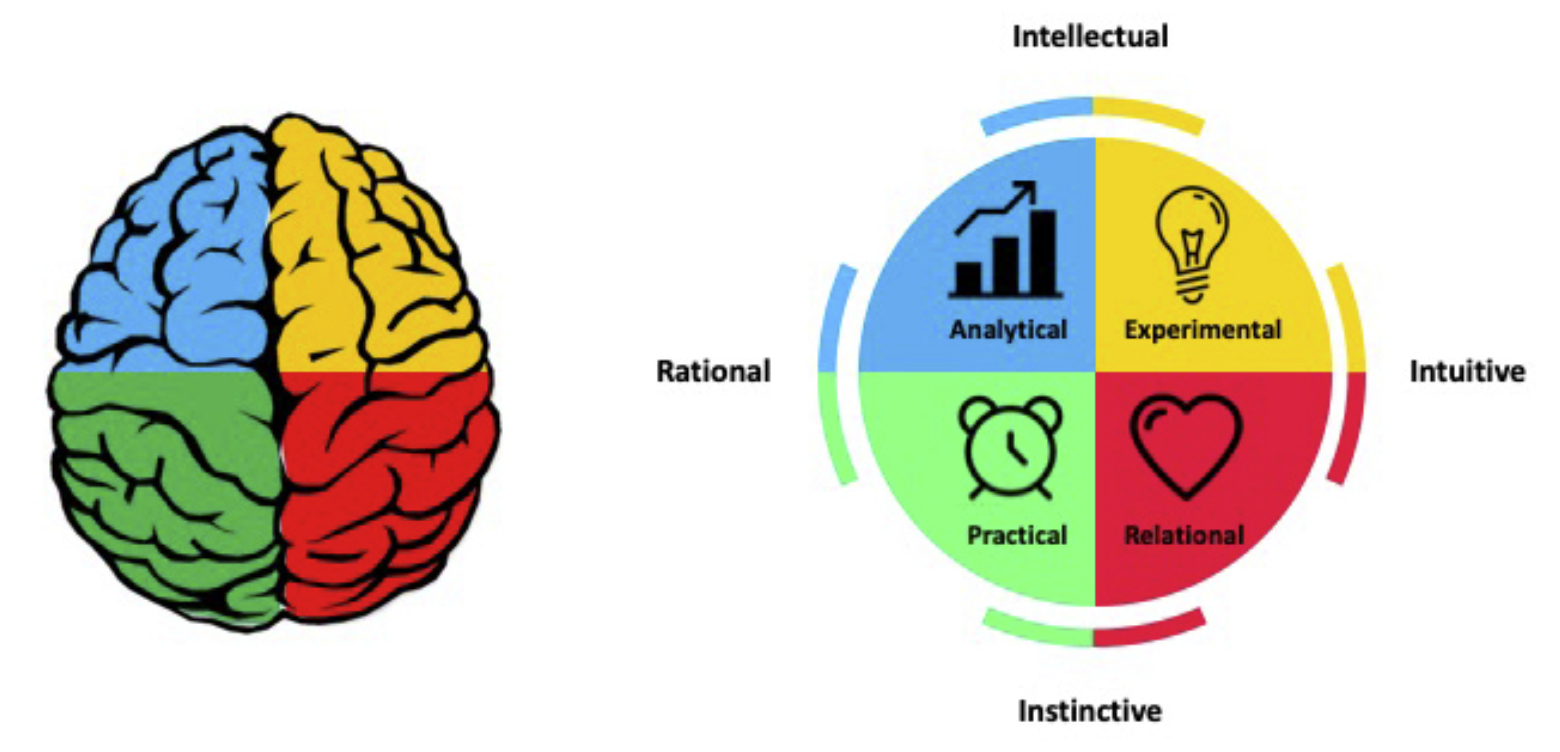
What Each Thinking Style Expects and Enjoys
| Quadrant | Thinking style | Tends to ask | Expects | Enjoys |
|---|---|---|---|---|
| A - Blue | Analytical | What? | Clear, concise information; well-articulated ideas; accuracy and certainty | A good debate; critical analysis; readings |
| B - Green | Practical | When? | Step-by-step unfolding; a detailed program; punctuality; an explanation of how | A structured approach; low risk; concrete examples |
| C - Red | Relational | Who? | Involvement with others; personal anecdotes; an experiential approach; feelings to be considered | The personal touch; group discussion; harmony |
| D - Yellow | Experimental | Why? | An overview; a conceptual framework; freedom to explore; analogies and metaphors; visuals | Initiative and imagination; connections to other approaches; newness and fun |
Most of us identify with more than one quadrant. Together, they describe a complex self made up of our rational, theoretical self; our ordered, safekeeping self; our emotional, interpersonal self; and our imaginative, experimental self. Your highest-scoring quadrant is where you tend to start, but the others are still part of you.
Why does this matter for teams and collaboratives? Because each thinking style brings different strengths and expectations for teamwork. The analytical colleague who asks for the data, the practical colleague who wants a clear plan and timeline, the relational colleague who wants to check in first, and the experimental colleague who wants to explore the big picture are all contributing something. Conflict can arise when each assumes their way is simply how work is done.
For more on how thinking styles shape meeting design, see Designing Meetings for All Thinking Styles in the Effective Meetings module.
Our Many Parts
The Whole Brain Model gives us shared language for differences in how people work. But it describes our preferences, what we reach for when things are going well. But we aren’t always at our best. Sometimes you feel overwhelmed, stuck, or burnt out. When you are feeling that way it may seem like the problem exists outside of you - we take on too much work, other people aren’t pulling their weight, etc. - but the source of the overwhelm (and the solution) may actually live inside of you.
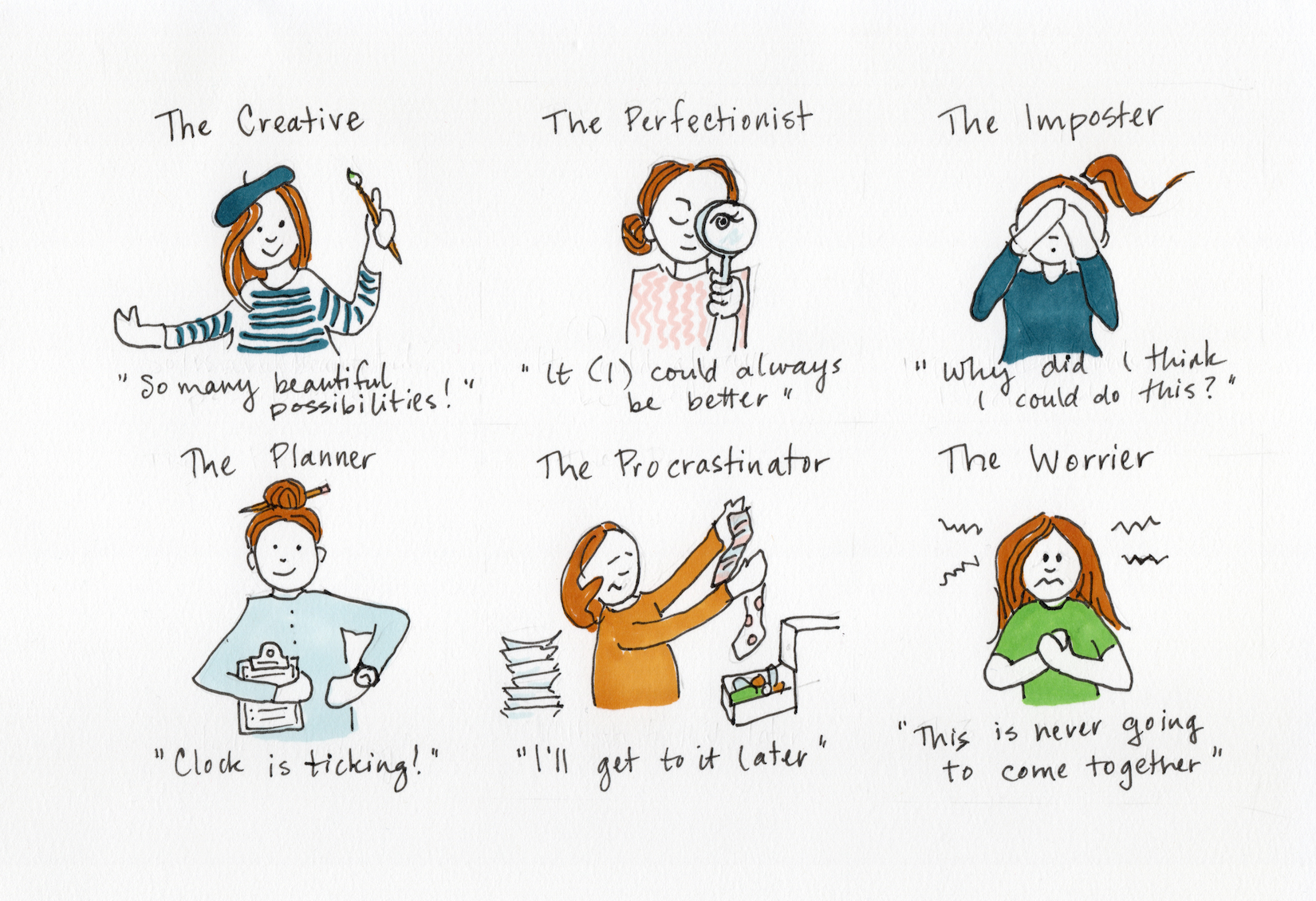
Internal Family Systems (IFS) is a model from psychology, developed by Richard Schwartz, that starts from a simple observation: all of us have multiple sub-parts. They have different needs, fears, and ways of responding, and they compete for control over how we show up at any given moment. As Natalie Rofthels writes, “Some parts help you manage your time, and other parts help you lose track of time entirely; some think analytically, and others work intuitively and non-linearly; some strive for individual excellence, and others prioritize collaboration with your colleagues; some feel competent and confident, and others criticize you and tell you you’re not enough.”
When we are feeling stuck, it’s often because some voices have gotten really loud or are locked in an internal conflict, pulling you in different directions. The trick is to notice and listen to the competing voices within you.
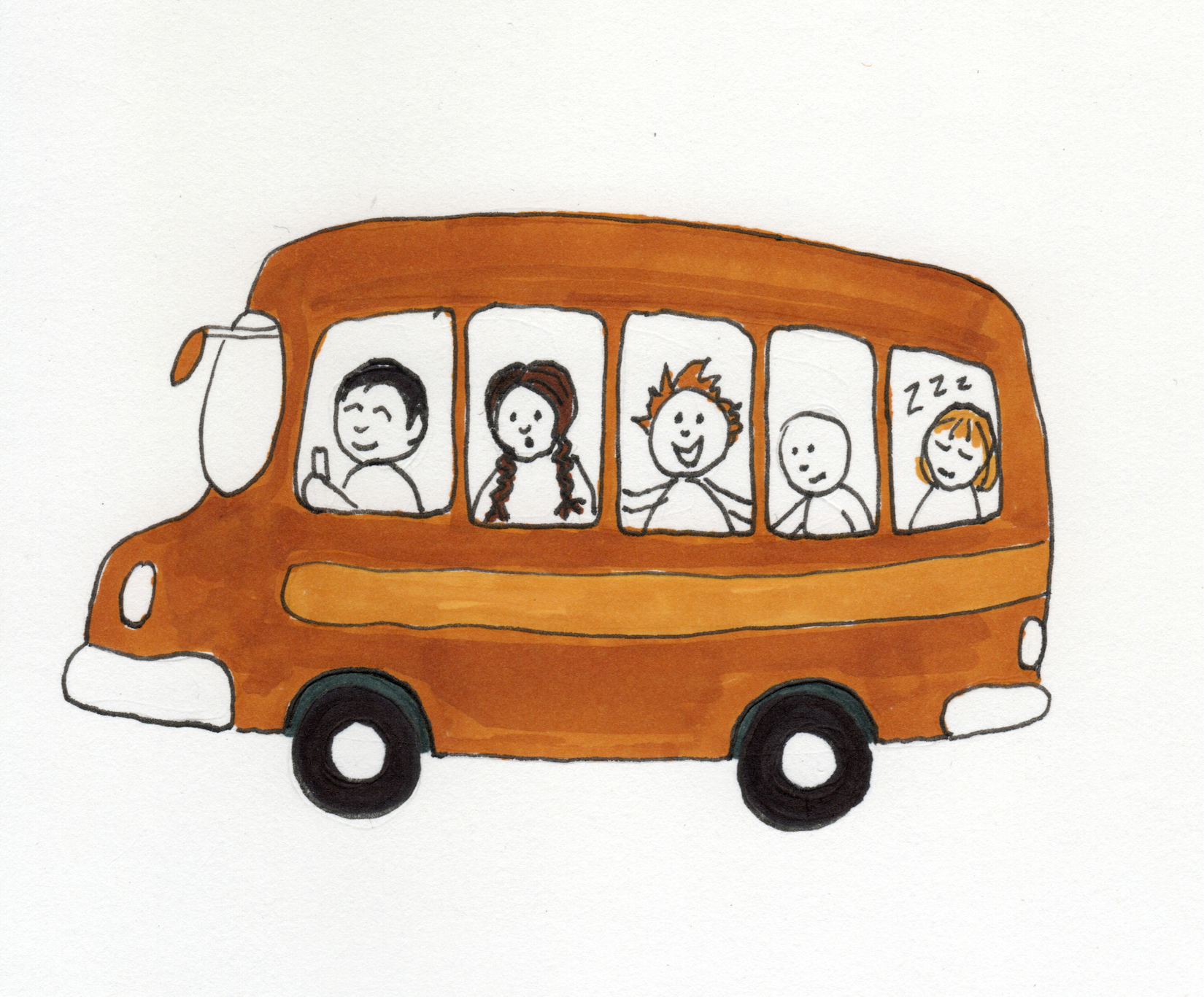
A helpful way to picture this is an internal bus. You are on the bus, and so are all of your parts. At any given moment, one of them is in the driver’s seat, whether or not you are aware of it. The part that jumps in with solutions, the part that gets defensive, and the part that wants everyone to get along may each take a turn at the wheel. Even the same person can show up quite differently depending on what is going on.
Three additional ideas make this lens especially useful for teams:
- All of our parts have positive intentions. Each is trying to help or protect us in some way, and each carries hope and wisdom. The part that gets defensive in a feedback conversation, for instance, may be trying to protect us from feeling like we’ve failed.
- We each have a wise inner Self. This Self can help integrate our many parts and facilitate a dialogue among them to move through inner conflict. Ideally this wise Self is in the driver seat most of the time. When the Self is in the driver seat, people describe a feeling of being “centered.”
- Awareness creates choice. We cannot always control which part reaches for the wheel, but when we notice who is driving, we have more room to respond thoughtfully instead of simply reacting.
A note on how we use this: we are borrowing IFS as a reflection tool for self-awareness at work. This is not intended as a form of therapy, and nothing here requires you to share more than you want to.
Tool Highlight: Reflection Prompts for Your Parts
You can use these prompts on your own, in a journal, or in a conversation with a trusted colleague. They work best when you ask them with curiosity rather than judgment.
- Which part of me has been most active this week? What was going on when it showed up?
- What is that part trying to do for me? What is it afraid of or hoping for?
- How does it tend to show up in meetings or in conversations with teammates?
- What does it need to feel more settled?
- What would I want my teammates to know or do to help the part of me that does my best work take the wheel?
Core Values
Our values are another way to understand what is driving us. They are the beliefs that are most important to you and that fill you with purpose. They should resonate deeply with how you identify as a person. You may already know what your core values are.
If you want to discover them, Brené Brown’s work offers a practical starting point:
- Scan her list of values; feel free to add new values or put these in your own words.
- Narrow it down to the two or three that are most central to you. You may want to start by circling 10-20 that resonate with you and then whittling down your list.
- Your secondary values may be nested under your core values - your commitment to those values is likely fueled by your one to two core values (e.g., my commitment to collaboration is fueled by the value I place on learning and making a difference)
Once you have identified your core values, sharing them with team members or collaborators can be a powerful way to build understanding and empathy. And you can start to practice aligning your behavior more intentionally with your values. Explore the prompts below on your own to deepen your understanding of how your values shape how you show up.
Tool Highlight: Living into Your Core Values
You can use these prompts on your own, in a journal, or in a conversation with a trusted colleague or friend.
- What does it feel like when you are living into your values?
- What are early warning signs for you that you are out of integrity with your core values?
- What are 3-4 behaviors that support you in living into each of your core values?
- What are 3-4 slippery behaviors you find yourself tempted to engage in even though they are counter to your core values?
- Who is someone who knows your values and supports your efforts to live into them? What does support from this person look like?
- How does living into your values shape the way you give and receive feedback?
- What can you do as an act of self compassion to support yourself in the hard work of living into your values?
Read back over what you wrote. Circle words or phrases that stand out to you. Identify a behavior that supports your core values that you want to focus on in the coming months.
You at Your Best
We now have three lenses: how we prefer to work, our core values, and what shows up under stress. This next step pulls them together around one question: what helps you do your best work?
You just named what you need. Now imagine everyone on a team did the same, and most of it was never said out loud. How does a team figure out what everyone needs, and then act in accordance with that?
Working Agreements
One way is through working agreements: statements of how we will show up with and for each other.
Why are they valuable? Working agreements:
- Allow team members to communicate what is important to them and how they like to work
- Help create the conditions for everyone to show up as the best version of themselves
- Increase mutual accountability, because expectations are visible and shared
A Note on Terminology
You will hear working agreements called many things. The names overlap, and what matters more than the label is whether the team made them together and they do real work. That said, the terms carry slightly different connotations, so choose the one that best fits your team culture and context.
| Term | Typical feel | Where it fits best |
|---|---|---|
| Working agreements | Practical and team-made: how we will work together day to day | Ongoing teams and project teams |
| Ground rules | Short, often set by a facilitator, for a particular meeting or session | One-off meetings, workshops, and convenings |
| Norms | Can describe how a group actually behaves as well as how it intends to | Groups reflecting on or reshaping their existing culture |
| Principles | Higher level and values-based, less behavioral | Guiding the overall approach of a collaborative, alongside agreements |
| Code of conduct | Formal, often organization-wide, tends to imply standards and consequences | Organizations, large communities, and events |
| Collaboration agreement | Partnership-flavored, can sound contract-like | Multi-organization collaboratives and client partnerships |
Words like “rules” and “code of conduct” can sound imposed, while “agreement” signals shared ownership. When you work with a client or a larger collaborative, check what language feels comfortable to them. Or ask the group what they want to call it. How people respond is a quick test of whether they feel ownership.
Where Might We Need Them?
Working agreements are useful anywhere people work together over time, across the nested scales at which we work:
- Internal teams - to set expectations for communication, meetings, availability, and decision making
- Collaboratives and partnerships - where no one is in charge by default and agreements are part of setting the culture of the collaborative
- Clients and consulting engagements - to understand and show up in the way your client expects and enjoys
- Communities - to define how members engage with each other
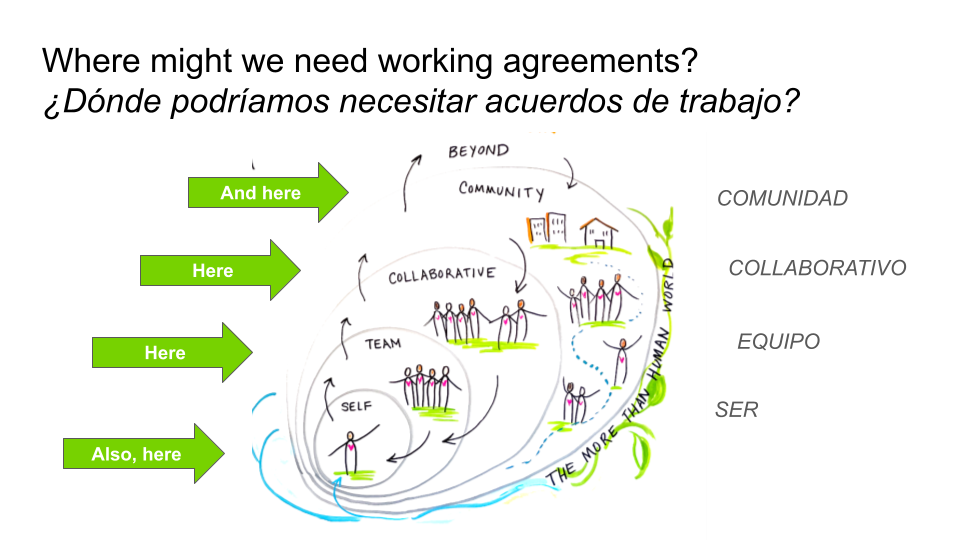
You may even want to consider some commitments you want to make to yourself to help your best self show up in the workplace. Maybe you agree to speak your needs to the group, even when it causes you discomfort, or to get adequate sleep, exercise and nutrition to sustain your energy. What do you need that only you can provide?
Ingredients of a Good Agreement
Not all agreements are equally useful. “Communicate openly” and “respect each other’s time” sound good, but they don’t tell anyone what to do. Strong agreements tend to share five ingredients:
| Ingredient | What it means |
|---|---|
| Specific and behavioral | Says who does what, by when, so you could tell whether it happened |
| Tied to a real need | Exists because it supports how people work best, not because it sounds good |
| Plans for exceptions | Says what happens when it can’t be followed or gets broken, and who decides |
| Co-created | Built with everyone who is expected to follow it, not handed down |
| Revisited | Includes a point to check whether it’s working and adjust |
The first three of these ingredients live in the wording of the agreement. The others (co-created, revisited) speak to the process for creating and implementing the agreement. These might not be explicit in the language, but they make the difference between an agreement people follow and a poster on the wall.
Weak and Strong Examples
| Context | Weak | Strong | What the strong version adds |
|---|---|---|---|
| Communication | “We’ll communicate openly.” | “If you’re blocked or going to miss a deadline, tell the team as soon as you know, not at the next check-in.” | Specific and behavioral: you could tell whether it happened |
| Meetings | “We’ll respect each other’s time.” | “Meetings start and end on time. Agendas go out 24 hours ahead, and we release the meeting time if there’s nothing for the agenda.” | Observable actions with a clear trigger; also serves people who need prep time |
| Responsiveness | “We’ll be responsive.” | “We respond to messages within one working day. For anything urgent, call or text. Otherwise, we won’t expect a same-day reply.” | Defines what “responsive” means and separates urgent from non-urgent |
| Decisions | “We’ll make decisions together.” | “For decisions that affect everyone, we gather input for a week, then the project lead decides and explains the reasoning. For small decisions, whoever owns the task decides.” | Clarifies how “together” works and who holds authority |
Here is an example that includes all five ingredients:
“We keep Fridays free of internal meetings so people who need uninterrupted time can do deep work. If something urgent comes up, anyone can ask for an exception, and the team lead decides. If we notice this isn’t working, anyone can raise it at our next check-in, and we’ll revisit it.”
It is specific (no Friday meetings), tied to a need (protected focus time), has a plan for exceptions (how to ask, who decides), and has a review point (the regular check-in). It also only works if the team agreed to it together.
Sounds Good, but Is It Tied to a Need?
An agreement can be specific and still fail the test, because it is borrowed from a general idea of what good teams do or from one person’s preference, instead of coming from the people in the room.
- “No emails after 6 pm.” Sounds like good work-life balance, but it solves a problem nobody has if the team spans time zones or some people prefer to clear their inbox in the evening. A need-based version might be: “Nothing sent after 6 pm requires a response before 10 am the next day,” which addresses the real concern of not feeling on call.
- “Everyone keeps their camera on.” Sounds like it builds connection, but it adds friction for someone with a poor connection, a need to move around, or camera fatigue. The underlying need, feeling connected and knowing people are engaged, can be met in other ways.
- “We’ll start every meeting with a check-in round.” Great for relational thinkers, but it may feel like a time-waster to someone who wants to get to the agenda. If no one on the team has expressed a need for it, it is a nice idea and not (yet) an agreement.
The question to ask is: What need does this serve, and whose need is it? An agreement that comes from one person’s need isn’t automatically wrong. “I need agendas ahead of time” can become a team agreement if others see the value or can easily accommodate it. The point isn’t that everyone shares the need. It is that the need is visible, so people can make a real choice instead of agreeing to something that sounds good.
Because agreements should be based on the needs of the actual humans trying to work together, they should be built by the team, for the team and revisited whenever team composition shifts. Some moments when it is especially worth having this conversation include:
- At the start of a meeting you are facilitating for a new group or a group that comes together infrequently
- At the beginning of a new year or new project
- When team membership or leadership changes
- When you begin working with a new client or partner
Starting the Conversation
Working agreements can be built through many kinds of conversations, from a quick check in at the start of a meeting to a more in depth team process. When working with a new client or partner, an initial intake conversation is a great way to elicit material for working agreements. We do this at the start of a relationship, not once friction appears, so that we can show up in the way our partners expect and enjoy. Below are some example questions you can use when establishing a new partnership or client relationship. And here’s an example agenda for an initial client launch meeting with some of these questions embedded – feel free to reuse and adapt!
Sample Questions
Communication
- How do you prefer to communicate and what are your urgency levels for each channel, e.g. Slack DMs for general updates, texts for emergencies.
- If someone on the team needs an immediate response, what’s the best way (email, text, phone call)?
Availability & Scheduling
- When will you be available for the team? What are your standard working hours?
- Do you have preferred times for one type of work over another, e.g. you want to write in the mornings and have meetings in the afternoons?
- How much advance time do you need for scheduling calls or virtual meetings?
Approach to Collaboration
- How do you prefer to collaborate? Do you like to confer then divide up tasks and work side by side? Be given specific tasks to complete and then report back? Work on the same task simultaneously (e.g. in a shared doc)?
- What are your superpowers (strengths)? What are you great at and love?
- What’s your kryptonite (weaknesses)? What stresses you out, and how can we navigate that stress?
- What do you want help with or want to delegate?
- A meeting / collaboration pet peeve is…
- What suggestions do you have for making the best of our collaboration?
Reflection & Review
- I think best by… (e.g. writing, having time to reflect, talking, drawing, moving…)
- How much advance time do you need for reviewing things?
- Do you prefer to iterate early drafts or see polished products?
Platforms and tools
- What platforms and software tools do you use for sharing documents, communication, virtual meetings?
- Are there any you cannot use due to institutional restrictions?
Matching Depth to Context
You don’t need to use every lens every time. Match the depth of the conversation to the relationship and the level of trust:
| Situation | Approach |
|---|---|
| A new client or short-term collaboration | A light work style questionnaire: quick, practical, and low-vulnerability |
| An ongoing team with some trust | Thinking preferences, plus the “you at your best” reflection, to understand each other’s defaults and what matters |
| A team with real trust, or one working through friction | Add the parts reflection, which asks for more openness |
What Agreements Can Be About
If you’re not sure where to start, here is a menu of topics that agreements commonly cover:
- Equitable participation and inclusivity
- Communication norms (e.g., openness, honesty, vulnerability)
- Giving and receiving feedback
- Communication channels and response times
- Meetings (purpose, length, agendas, who attends)
- Availability and working hours
- Review and feedback (how much time, in what form)
- Decision making authority and model (scope and who and how we make decisions)
- How we handle disagreements, mistakes, and slipped agreements
Tool Highlight: Min Specs
Min Specs is a Liberating Structure well suited to developing working agreements, especially with experimental thinkers who may be wary of lots of rules. Individuals brainstorm the things the group must do or must not do to achieve its purpose, share in pairs or small groups, and then pare the list down to the minimum set of rules the group could follow and still achieve its purpose. It pairs naturally with 1-2-4-All for engaging everyone. For more on these and other microstructures, see the Effective Meetings module.
Practice: Co-developing Working Agreements
You’ve seen the ingredients and a real-world example. Now it is time to try it. Your drafts don’t need to be perfect. We are practicing the process.
Taking It Back
The point of this session is to equip you to use these tools in your own work: with your internal teams, with partners or clients, and in the collaborative teams we facilitate. A few reminders as you do:
- Start with the “why.” People are more willing to engage when they understand what agreements are for and what’s in it for them.
- Choose the right depth for the situation. A new client may only need a few quick work style questions. A longer-standing team may be ready for more.
- Make the process as inclusive as the content. Use the same moves you would use in any good meeting: give people time to think before sharing, offer different ways to contribute, and invite quieter voices.
- Name the need behind every agreement. If you can’t, it may be a candidate for dropping or revising.
- Plan to revisit. Teams change, and so do needs.
Revisiting Agreements
Agreements aren’t set in stone. Build in regular check-ins, such as a standing agenda item once a quarter, or a trigger like a change in membership or leadership. Some simple prompts:
- What’s working?
- What’s not working, or not getting followed?
- What’s changed since we wrote these?
- Is anything missing?
And one more time, the question that ties it all together: What do I need, what do you need, and how do we agree to work together so everyone can do their best?
Additional Resources
Books
- Brown, B. Dare to Lead: Brave Work. Tough Conversations. Whole Hearts. Random House. 2018.
- Herrmann, N. The Whole Brain Business Book. McGraw-Hill. 2015.
- Lipmanowicz & McCandless. The Surprising Power of Liberating Structures: Simple Rules to Unleash a Culture of Innovation. Liberating Structures Press. 2014.
- McCandless, K. and N. White. The Liberating Structures Fieldbook: Flipping the Script on Meetings, Plannings, and Progress. Liberating Structures Press. 2026.
- Schwartz, R. No Bad Parts: Healing Trauma and Restoring Wholeness with the Internal Family Systems Model. Sounds True. 2021.